Showing posts with label maintenance. Show all posts

Monday, June 25, 2012

Passion For Maintenance Reliability


Passion For Maintenance Reliability
by Terrence O'Hanlon, Publisher and CEO Reliabilityweb.com and Uptime Magazine

I have been thinking a lot about the different people and the different maintenance reliability programs I come into contact with.  What are the differences between a high performance program and one that is not?

Many winning programs have one or more passionate and driven people who are involved with leading the program.  They may or may not be the managers but they are most certainly leaders.  They are empowered people who know what actions to take to move the company forward.  They are passionate about improving company performance, sometimes in spite of the fact that the company may not want to do some of the things they must to improve reliability performance.

These individuals are also passionate about improving themselves – which is why I get to meet them.  Regardless of how experienced or seasoned they are, they are active participants in learning and networking events like the International Maintenance Conference, the Reliability Centered Maintenance Managers’ Forum or the Predictive Maintenance Technology Conference.    We consider ourselves lucky that these leaders join our events each year and that drives us to deliver high quality sessions.


They attend these conferences, not because they are missing knowledge, but because they tend to keep their minds open and fresh for new ideas, approaches and strategies.  Even though they already have high performance reliability programs, they wake up early, they attend keynote sessions, they sit through workshops, they ask questions during presentation sessions and they network with other attendees.

In other words, their passion drives them to improve themselves so they can improve their company.

Are you passionate and driven to improve yourself?

Monday, June 11, 2012

Is there a reliability intelligence failure at your organization?


Is there a reliability intelligence failure at your organization?
by Terrence O'Hanlon, Publisher and CEO Reliabilityweb.com and Uptime Magazine

I just finished reading an article that reported on a recent Pentagon study about our battlefield effectiveness and performance in the Iraq and Afghanistan wars.

The report states, “that U.S. troops didn’t understand the basic realities of society, culture and power structures in Iraq and Afghanistan, and couldn’t explain what they were doing to skeptical populations.”

We were slow to recognize the importance of information and the battle for the narrative in achieving objectives at all levels,” according to a May 23 draft of the study.”

In operations in Iraq, Afghanistan and elsewhere,” the report reads, “a failure to recognize, acknowledge and accurately define the operational environment led to a mismatch between forces, capabilities, missions and goals.”
The report considers these issues less a strategy failure than an intelligence failure.

Think about that.  The United States military arguably has the best strategies, techniques, technologies and tools available yet by ignoring things as important as the local culture and history, they were not able to use the resources to their advantage. They suffered intelligence failures.

In addition, the U.S. soldiers and leaders were unable to effectively “tell the story” of the mission to the locals in a way that they would not only stop them from undermining U.S efforts but might actually get them to “buy-in” and “support” the mission goals.

The Pentagon thinks that understanding culture and using an effective narrative is so important that one solution you will likely see in the future will be a sociologist embedded with U.S. forces in order to get a better understanding of local culture.

Does any of that sound familiar to you?

While your maintenance reliability program likely does not enjoy the level of resources available to the U.S. Military, you probably have a good strategy, good techniques, good technologies and tools.

Do you have a full understanding of the workforce culture? 

Are you and your team members able to tell the story (the narrative) of your reliability mission so that operators, purchasing and management “buy-in” and “support” the goals? 

As a maintenance reliability leader, you must be an effective Reliability Sociologist to ensure you understand the culture of the workforce you will be working with and the story that your own team is telling.  That is how you will win the battle and the war!

Please comment on these points.


Saturday, June 9, 2012

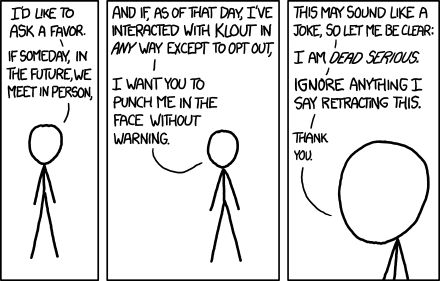
Do I have any Klout?


Do I have any Klout?
by Terrence O'Hanlon, Publisher and CEO Reliabilityweb.com and Uptime Magazine

No I do not mean clout – which is my influence in the real world.  I mean Klout  -my influence in the digital world. 

That is right, there is online influence tracking service – whether you want it or not – that tracks your influence over others.

I am not sure exactly how it knows my influence but it seems to have something to do with my use of Twitter, Facebook, LinkedIn, Google+ and my Maintenance Talk Blog.

Are they serious?  Yes.  Should you care?  Maybe. 

Admit it, we all love ranking and I will wager that more than a few of the people who read this post will visit Klout to see if they are ranked and if so – what their ranking is.

I have even read a Wired Magazine article where a person has lost a job opportunity simply because his Klout Score was too low. 

Here is what I have to say on the subject.

If you have something valuable to say and you have an audience to say it to, then you have Clout (and possibly some Klout).

If your messages are simply promoting, selling and marketing oriented, you may earn some Klout but you do not really have Clout!


Tuesday, June 5, 2012

That is the way we have always done maintenance around here


That is the way we have always done it around here

How many things, tasks, and activities are you doing because that is the way things have always been done?

Are you simply accepting that there must be a reason to be completing these tasks? Surely someone (much smarter than you) thought there was enough reason to begin the tasks in the first place.

Make sure that you take the time to do a periodic review of your maintenance tasks and ensure that each is designed to:

  1. Prevent a failure
  2. Detect a failure
  3. Comply with a law or regulations


There are many methods you can use including Reliability Centered Maintenance, PM Optimization, Maintenance Task Review and more to ensure your efforts are aimed toward the right targets.


As for the third justification for maintenance tasks – that it is somehow regulated or required by an external authority even if it is not adding value – can be a lucrative opportunity for improvement during a review process.

Because the consequences for violating a regulation or law can be significant, most people will simply accept “we cannot change it because it is required by (insert the name of the authority here).”

Are you sure?  Who says so anyway?  Have you done a review to verify if the procedure is actually required and can be traced to a specific regulation or is it an internal process that gained validation by claiming to meet an unspecified regulation?

You may find some tasks, processes and procedures that can be eliminated.   If they were not adding value – then you are getting a great deal of return for having taken the time to verify and validate that there is or is not a reason to be conducting them.

Do yourself a favor and schedule a maintenance task review as soon as possible. 

Here is a semi-related article from the brains at Harvard Business Review titled
Learned Helplessness in OrganizationsI hope you find some value in reading it.

Saturday, June 2, 2012

Uptime Magazine June/July 2012 Issue on online


Uptime Magazine June/July 2012 Issue on online 

The latest issue of  Uptime® Magazine is now posted online featuring:

  • Bridging the gap between construction and operations
  • Pump improvement opportunities increase uptime
  • Maintenance reduction with a computerized maintenance management system (CMMS)
  • Implementing Electrical Signature Analysis as part of your Predictive Maintenance (PdM) program
  • Motor performance management
  • Using metrics to influence maintenance planning and scheduling
  • Business excellence
  • Eliminating lubrication cross contamination
  • Oil Analysis: Journey to discovery
  • A toothpaste factory had a problem
  • OEE Goals based on Customer Takt Time
  • Way of life at Luminant
  • Interpreting Vibration Analysis Faults
  • Level 5 Leadership at Work
  • Much more…


Get the digital issue at http://www.uptimemagazine.com

Uptime Magazine Best Maintenance Reliability Program Awards 2012


Uptime Magazine Best Maintenance Reliability Program Awards 2012

Do you think enough of your organization's maintenance reliability program to enter the Uptime Awards for 2012?

We have added a more comprehensive first round assessment that will provide you with value simply from completing the process of entering.

There is no cost for entering so why not give it a try?

Find out more at http://www.uptimeawards.com