Showing posts with label best practices. Show all posts

Saturday, March 23, 2013

What are the Uptime Awards?


Uptime® Magazine is a bi-monthly magazine devoted to asset management, reliability, predictive maintenance and machine condition monitoring. Part of our mission is to promote and acknowledge best practices.

We have created the Uptime Magazine Best Maintenance Reliability Awards to provide positive exposure and acknowledgment for maintenance reliability professionals from around the world.

The Uptime Awards were established in 2006 to:


  • Acknowledge organizations and individuals who have achieved high levels of performance in maintenance reliability
  • Provide a venue for Uptime Award winners to share information about their journey to high performance reliability
  • Encourage other organizations and people to adopt the practices of these high performance programs
  • Share a powerful self-assessment based on Uptime Elements — A Reliability System for Asset Performance Management


What are the benefits of participating in the Uptime Awards evaluation process?

Find out the benefits reported by previous Uptime Award participants here

Thursday, January 24, 2013

You Say You Want A Revolution


On the song Revolution that appeared on the White Album many Beatles experts think John Lennon wrote “We all want to change the world” and “We’d all love to see the plan” to express his doubts about the methods being employed by some of the 60s protest movements who wanted to use him as a sponsor or spokesperson.

I like to consider myself a Beatles expert of sorts and I think that John may have been trying to tell the maintenance reliability community something as well. For example:

You say you want a revolution well you know
We all want to change the world

Of course we all think that if the world around would only change – life and work would be so wonderful.    We all imagine what the default future looks like if nothing changes and sometime s the language we use to describe that future actually plays an important role in serving that same future to us..  What John wanted us to know is that each one of us can write a new future by changing the responses we have to world around us – and in that way – change the world.


You say you got a real solution, well you know
We'd all love to see the plan

I think what John is saying is that many of us think we know the solution to the challenges we face but very few of us have a plan and those that do have a plan often fail to invite the stakeholders to help write that plan.   You will not be able to move away from the default future until you invite everyone involved to co-author the future with you. 
          
You ask me for a contribution, well you know
We're all doing what we can...

In his infinite wisdom John Lennon is telling us not to wait for someone else to contribute.  If you begin with your own contribution, you will find it is much easier to get others to contribute.

You say you'll change the constitution, well you know
We all want to change your head

One way to look at John’s message here is to consider changing the language we use to describe how situations occur to us.  The words we choose to describe things often create the future reality for us.  Try to describe a challenge in a new way that includes possibility for change or improvement.  Try it again.
 
You tell me it's the institution, well you know
You better free your mind instead

John is letting us know that it is easy to blame “them”, “management” or “the company” for the way things are.  There are many things in this world that you cannot change however you have a choice about how your respond to things and what words your use to describe them.

John also seemed to know that if you read every article in every issue of Uptime Magazine:

Don't you know it's gonna be   Alright

Sunday, August 19, 2012

Maintenance Program Performance – It Is Just A Phase You Are Going Through


You may have your own idea of the phases that an organization goes through as they drive reliability improvements and you may not know mine yet, but you will if you keep reading.

The point is not what my vision of high-performance maintenance phases are; the point is for you to recognize your own organization and to keep moving to the highest level.

Babies to children to teenagers to adults to senior citizens is just one of the phases we can describe to relate to the human condition.  Phase identification allows us to create a better understanding by generalizing various descriptions attached to each category.

No one is born knowing how to create high-performance maintenance programs.   The good news is that there are volumes of maintenance books written, a few high-quality, professionally managed maintenance conferences and trainings to attend, excellent maintenance magazines to subscribe to and a world of maintenance oriented web sites to learn from.

Some useful things I think I have discovered as I became familiar with hundreds of maintenance programs over the past 30 years are:

  • The tactics and tools of high-performance maintenance are documented and well known
  •  The strategies for reaching high-performance in maintenance are documented and well known
  •  Once you have deployed basic tools, tactics and strategies there is another critical element that will determine the performance level of the maintenance program


Maintenance Program Development Phases

Although I agree with the traditional maintenance program phase description of reactive to preventive to predictive to reliability-based to asset health management, I want to look at things from a slightly different angle.

Survival Phase
With no investment in tools, tactics or training many organizations find themselves in “Survival Mode”.  There is not a master plan or formal movement toward creating a more reliable operating environment.  These programs are highly reactive and everything revolves around ensuring operations gets back to production mode as quickly as possible after the inevitable breakdowns occur.  Many “repairs” do not last long, however no one is formally tracking failures so repeat problems will be accepted as “what’s so”.    Maintenance leaders and team members simply work to survive each shift and understand that the plant manager and operations managers set the priorities and are the masters they must serve; regardless of lack of vision they demonstrate toward increasing performance.  In this phase maintenance is often held responsible (blamed) for most of the breakdowns.  In the Survival phase it is every man/woman for them selves.

Common Sense Phase
Often times organizations will luck into adding a maintenance leader to the team who can apply enough common sense to find ways to avoid the worst repetitive failures in spite of the lack of tools, technologies or a master strategy.   The Plant Manager and Operations Manager do no embrace this common sense approach, they simply adapt their expectations to the new normal.  If there is a measurable result from the common sense approach, it is usually claimed by operations.  Common sense maintenance leaders tend to prefer to avoid the spotlight anyway.  Common sense maintenance leaders are greatly admired by the other maintenance team members who are happy to be out of Survival Mode.


Tools and Tactics Phase
When a Sales Representative brings in an Ultrasonic Detector for a demonstration, jaws drop and hearts skip a beat.   The team is excited and can see the value in expanding their senses to detect potential problems way before they could by using human senses alone.  The same holds true for vibration analysis, electric motor testing, oil analysis and infrared thermal imaging.

The problem I sometimes see is that many organizations simply add these “predictive” tools and the inspections tasks associated with them, on top of a reactive or preventive maintenance program.  They do not have a failure prevention or defect elimination strategy so a shot gun approach is taken and with enough low-hanging fruit to pick, everyone soon falls in love with the new reactive “Predictive” maintenance program. 

The same holds true for adding maintenance planning and scheduling.  I have seen many organizations that were very effective at planning the wrong work.  They could plan work but that work did not prevent or detect failures and some times that planned work even caused additional failures.

Last but not least, a pet peeve of mine are maintenance programs that substitute FMEA (Failure Modes and Effects Analysis) for RCM (Reliability-Centered Maintenance) or PM Optimization (PMO) for maintenance task analysis.  Per my friend and Reliability Centered Maintenance Using RCM Blitz book author Doug Plucknette, FMEA falls short because:

  • Failure Modes are assessed at a higher level
  • It does not use a formal decision process to determine the correct tasks
  • It does not consider what should be done if there is no applicable or effective task


FMEA is a tool and does not a strategy make!

Tools and tactics are needed for high-performance maintenance, however having them and aiming them are two different things.

Maintenance leaders and team members in the Tools and Tactics phase know or at least sense that there are positive ways forward.  Many times they begin to see the possibilities that come from a high-performance maintenance programs.  Other programs languish in this area and I believe it comes from maintenance leaders who have become comfortable and are often highly acknowledged by top company leadership for picking the low hanging fruit and creating (temporary) results.  These leaders are unable or unwilling to formally adopt the high-performance maintenance strategies that are already so well documented and proven. 


Strategies Phase
Since 1978, the concept of Reliability-centered Maintenance (RCM) has been spreading as a dominant strategy for almost all high-performance maintenance programs.  In summary, RCM shifted efforts from maintenance as “fixing things” to maintenance as “ensuring that things functioned” as the asset owner requested.  Using a disciplined analysis techniques, failure causes and consequences were identified and intervention and prevention strategies were developed.

Living programs and Root Cause analysis allow the strategy to be continuously improved and Reliability Engineering methods like Weibull Analysis provide even more resources for performance.

The strategy phase is much harder to create and fully implement than the tactics and tools phase.  Think about your top management when they hear that their top talent is locked away in rooms – sometimes for weeks at a time, talking about failure that “might” occur.    Executives who lack vision often see very little value in this approach and only support a small fraction of the resources that are needed to fully implement and apply this strategy.  If that is not bad enough, almost everyone else in the company will not only resist this new strategy, some will actively work to undermine it because of the change it represents to them.  Undermining a strategy is much easier than successfully implementing one.


Culture Of Engagement
Please understand that I am a big fan of the tool, tactics, technologies and strategies that are well-documented and proven effective for high performance maintenance programs.  The problem I have seen is that too many programs that were tool, tactic and strategy focused failed to deliver sustainable business results and often fall back into early cycle phases that repeat every decade or so.

I call it the Vicious Cycle Of Maintenance Improvements and it results when the past improvement efforts fail to engage the other members of the organization.  When universal engagement is lacking, improvement programs are at risk from funding reduction, manpower reduction, key personnel changes and many other short-term decisions that come from above.


In order to create a culture of engagement, everyone involved in making the journey to high-performance must see how that journey relates to him or her.  They must know that they are respected as people, that their ideas are heard, that they have some ability to impact the performance and that this new and different performance level benefits them in some way.   That takes much more than telling them about it once or twice.

In order to ensure that your maintenance program reaches and sustains a high-performance level, you must ensure that you get the tools, tactics and strategies right enough to generate consistent business results.  You must also make those results highly visible to everyone in the organization.

As made abundantly clear by Winston Ledet’s Heroic Change series of books, what works in one culture may not work in another.  As William Shakespeare so eloquently writes in Hamlet “therin lies the rub” meaning having the answer is no answer at all.  Knowing the people you work with and what makes them tick is as important if not more important than knowing the right tools, tactics and strategies for improved equipment reliability.


Listen and learn more than you speak and teach if you want to remain in the top phase of high-performance maintenance.  Engage everyone in your organization in high-performance maintenance if you want to sustain the results.

Tuesday, July 24, 2012

7 Traits of High-Performance Reliability Programs

by Terrence O'Hanlon, Publisher and CEO Reliabilityweb.com and Uptime Magazine


It is no wonder that company management looks at maintenance with a jaded perspective.  Many of them still think of maintenance as a necessary evil that is just a cost of doing business.

I am referring to failed reliability improvement initiatives. Research conducted at Reliabilityweb.com shows that approximately 85% of these improvement initiatives fail to create sustainable business gain.

Some improvement efforts do makes things better for a little while but then they return to the previous state or worse.  We call this “bureaucratic elasticity”.  Like a rubber band being stretched outward, it only remains in that position while it is being held.  Once released it returns to its original position.

Maintenance leaders often follow the “silver bullet” approach because they met some “expert” who sure seemed credible as they explained the “only way” to make improvements.  (The “only way” also happened to be the method that this consultant knew about).  If your maintenance consultant is telling you about the “one way” to make the journey to high-performance reliability, run away fast.  There is no such thing.

Things like Reliability-centered maintenance (RCM), Computerized Maintenance Management Systems (CMMS), Predictive Maintenance (PdM) or Maintenance planning and scheduling are all fantastic improvement strategies and tools, however the power for change is not resident in the tools themselves.

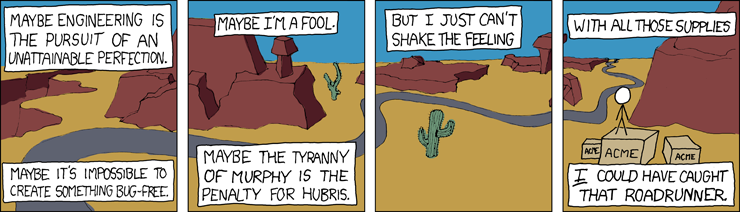
Do you recall Wile E. Coyote, the Warner Brothers cartoon character that was always trying to capture and eat the Roadrunner?

I do not know where he got his budget but his wily mind was able to engineer very elaborate plans using a wide variety of strategies, tools and technologies (all available from Acme Manufacturing), however none of them ever delivered a meal to his plate.

Even if Wile E. Coyote had managed to catch and eat a roadrunner, would he be able to repeat it?


Of course as maintenance reliability leaders, we need to use any strategy, technology and tool that will help us reach our performance goals, but the lessons of the last 30 years have demonstrated that creating a sustainable high-performance reliability level is not a by-the-book journey.

Since 2006, Uptime Magazine has hosted the Best Maintenance Reliability Program Award or Uptime Awards for short.  Over the years we have found 7 traits that each of these winning high-performance programs share:

1) Each program developed maintenance and condition monitoring tasks based on criticality ranking and failure modes and effects analysis. In other words they understood how their machines failed and how important they were to company goals.  They directed maintenance activity to detect or prevent potential failures on the right machines at the right time.


2) Each program had earned a high level of active corporate support and respect by starting small, assessing the result, improving, then expanding.  Company leadership did not simply endorse the reliability improvement program; they understood it and actively guided it so it could survive competing initiatives and temporary loss of faith.


3) Each program excelled in communicating up the chain, down the chain and across the chain.  All stakeholders and interested parties had a high awareness about the benefits of the program.

4) Each program included short and long-term training and certification for team members that were far higher than what we typically find in lower performance companies

5) Each program included passionate and energetic people who were highly motivated to perform at high levels.  Many of these people had no management authority however they were clearly leaders who possessed initiative.


6) These programs reported gains in safety, productivity and reliability on a regular basis to justify and sustain the reliability improvement program.


7) Each program subjected itself to annual assessment in order to identify current gaps, and then created follow-up plans to close those gaps.  They expect to continually improve with no end in sight.  If you have been through an honest assessment, you know how painful it can be.


Are you still chasing the roadrunner?


It is clear that leadership and culture are very important along with use of the best reliability strategies, technologies and tools.  The human side of reliability is ignored at your own peril.

No one said it would be easy.  Making the journey to a sustainable, high-performance reliability program requires a lot of work, vision and perseverance.  Everyone I know that has made it reports that it is one of the most satisfying achievements of their life.


Here are some resources that might be useful for your journey


What are your thoughts about creating a sustainable high-performance reliability program?

Saturday, July 14, 2012

Unscheduled downtime should be a random phenomenon

by Terrence O'Hanlon, Publisher and CEO Reliabilityweb.com and Uptime Magazine

If you are still doing time-based or run-time-based maintenance (Preventive Maintenance or PM) as a primary maintenance strategy you should be aware of the "Waddington Effect".

20 years before Nowlan and Heap wrote “Reliability Centered Maintenance”, and way before John Moubray wrote RCM2 was work down by a British scientist named C.H. Waddington who was put in charge of British aircraft maintenance in WWII.

He stated that unscheduled downtime should be a random phenomenon.  If all unscheduled downtime events are plotted with respect to the last PM, there should not be any pattern evident.

Waddington concluded that the scheduled maintenance: “…tends to increase breakdowns, and this can only be because it is doing positive harm by disturbing a relatively satisfactory state of affairs. Secondly, there is no sign that the rate of breakdown is beginning to increase again after the 40-50 flying hours, when the aircraft is coming due for its next [scheduled preventive maintenance event].”

In other words the Waddington Effect states that scheduled preventive maintenance was actually doing more harm than good.

Have you formally tracked unplanned downtime that happens shortly after a scheduled PM at your company?

If you are not ready for more proactive reliability-based approaches, one thing you can do is to look at increasing the time or operating hours between PM's - a pretty simply solution if you are stuck in the Waddington Effect.

Tuesday, July 10, 2012

Reliability Transformation: New Thinking About Reliability

by Terrence O'Hanlon, Publisher and CEO Reliabilityweb.com and Uptime Magazine


Warning:  Your brain is not naturally wired to think reliability

If you are a maintenance reliability leader you can probably recall a time in the not so distant past when you were not aware of proactive reliability strategies.  Maybe strategy is not even the right word.   There was a time when you thought about maintenance reliability the way that the vast majority of people who actually think about maintenance do:

  1. Something is new and operates close to perfect
  2. Occasionally someone from the maintenance department shows up to lubricate, tighten things and possibly replace some fluid or filters
  3. The thing ages and requires replacement or major repair or rebuilding
  4. There is not much that can be done to create a longer operating life of the thing

Then you met someone who changed your mind or you started reading books, articles and blogs or you attended conferences where you learned a new way of thinking about maintenance.  You learned about the concepts of failure, consequences, condition monitoring, and reliability-centered maintenance.  You re-wired your brain to think VERY differently about reliability and what you might be able to do to improve it.

Let’s call this a “Reliability Transformation


Of course there are people you work with that have not experienced a reliability transformation yet but that does not mean they cannot do so – especially with your assistance.

Don't change beliefs – transform the believer ~ Werner Erhard


You can consider using some of the following Reliability Transformation tips:

  • Learn more than one way to present the concept of reliability.
  • Practice communicating the concept of reliability on friends, strangers, supportive and hostile listeners.
  • Check in with the listener often. Are they following? Let them ask questions.
  • Allow “white space” around the idea of reliability. Start at a very high level view.  Don’t overwhelm them with details
  • Try to close with actions – even if small. 


OK now I need to make a broad generalization about many of the maintenance reliability leaders I know.  They tend to talk in great detail and use examples that are too micro when they should be macro.  They also fail to tie these conversations to business results.  Feel free to file a dispute in the comments section below.

Can you refine and distill your conversation to support the concept of Reliability for your managers and other company leaders as well as floor level people who will be affected?


  • What are the BARE BONES parts of your concept about reliability and some of the changes that would be required?
  • How few words can you use, and still get meaning across? (Example: we will double production on line 1).
  • What part of the concept is most confusing? Can you change it?
  • Would a picture help?
  • How much can be explained later without hurting the conversation now?
  • What’s your next sentence, after this new, distilled one?


Are you willing to take responsibility for the way things are now and still create possibilities for a reliability transformation in your organization?

Let me know if you already have or will do so.  You can contact me through Google+ here


Saturday, June 2, 2012

Uptime Magazine Best Maintenance Reliability Program Awards 2012


Uptime Magazine Best Maintenance Reliability Program Awards 2012

Do you think enough of your organization's maintenance reliability program to enter the Uptime Awards for 2012?

We have added a more comprehensive first round assessment that will provide you with value simply from completing the process of entering.

There is no cost for entering so why not give it a try?

Find out more at http://www.uptimeawards.com